
.png)
This past July, the Office of the United States Trade Representative (USTR) announced tariffs against 60 economies for their failure to impose and effectively enforce prohibitions on imported goods produced with forced labor. According to the USTR, the 60 trading partners collectively account for 99.4 percent of U.S. imports.
Unlike the Trump administration’s temporary Section 122 tariffs that preceded them, the new Section 301 duties have no defined expiration date. They are, however, subject to modification, termination, and the four-year review provisions under Section 307 of the 1974 Trade Act.
The USTR established 10% tariffs on countries that: (1) impose a forced labor import prohibition; (2) have committed through an agreement on reciprocal trade to impose and enforce such a prohibition; or (3) have established a partial regime that prevents the importation of certain forced labor goods. A 12.5% rate applies generally to the remaining states, with separate arrangements for certain products from the European Union, Japan, Korea, Switzerland, and Taiwan.
Calibrating Tariffs to the Forced Labor Risk in the Caribbean
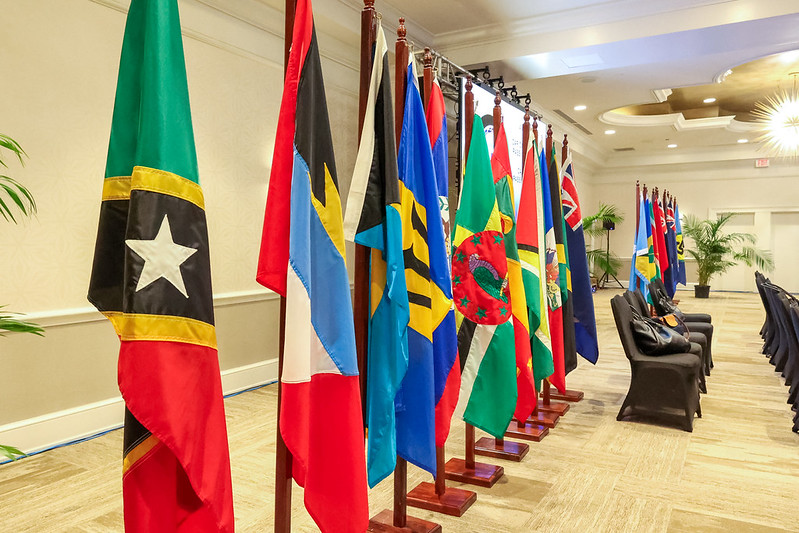
Four Caribbean countries — the Bahamas, the Dominican Republic, Guyana, and Trinidad and Tobago — are among the 60 economies subject to these new tariffs. Together they represented less than 1% of U.S. goods imports from 2021 to 2025. In 2025, the United States also recorded a combined goods trade surplus with these four economies. The new open-ended tariffs provide no clear path to removal, and the U.S. investigations that led to their imposition did not provide evidence that these countries’ exports were produced through forced labor. For these Caribbean states, the tariffs are a punitive measure and threaten regional trade stability.
In June 2026, Trinidad and Tobago’s Parliament passed legislation amending its Customs Act to prohibit the importing goods produced wholly or partly using forced labor. The USTR subsequently placed Trinidad and Tobago in the 10% category rather than the 12.5% category applicable to the Bahamas, the Dominican Republic, and Guyana. While this shows that the USTR is prepared to recognize policy changes, it also raises the question of what additional measures an affected country must take for the Section 301 tariff to be suspended or removed altogether.
The Dominican Republic provides an interesting case in this regard. On July 23, Dominican President Luis Abinader empowered the country’s General Directorate of Customs to prohibit the entry of goods linked to labor exploitation and issued a provision to strengthen inter-agency coordination and international cooperation. But the decree was issued late on the same day as the USTR’s imposition of the tariffs, and the public record does not establish whether the USTR had an opportunity to assess it before finalizing the Dominican Republic’s tariff treatment. This underscores the need for the United States to institute a transparent post-action review mechanism through which it can properly assess reforms adopted by affected governments.
The prohibition against forced labor is a firmly established norm in international labor standards and a longstanding U.S. policy. This matters for both human rights reasons — to prevent goods produced with forced labor from entering global supply chains — and free trade concerns, because goods produced through forced labor can outcompete ethically produced products.
The USTR’s Section 301 investigations, however, were narrower and trade-specific, focused on whether governments maintain and effectively enforce prohibitions on the importation of goods produced with forced labor.
The USTR determined that each investigated economy maintained policies or practices that failed to impose and/or effectively enforce an adequate prohibition on enforced-labor imports. Additionally, the USTR argued that these deficiencies permit goods and inputs produced through forced labor to enter international supply chains and distort competition in favor of producers benefiting from forced labor, undermining firms that comply with labor standards and contributing to circumvention of existing forced labor import prohibitions.
While these are legitimate trade policy concerns, the country-specific findings did not establish that particular exports from these investigated countries were produced using forced labor. The USTR also did not condition the additional duties on evidence that an individual Caribbean export or sector contained forced labor inputs.
For Caribbean countries, these duties are punitive. The tariffs apply to most goods from an affected economy, subject to some product exemptions, rather than only to goods or supply chains in which forced labor has been identified. To truly address forced labor, U.S. policy should be more closely tied to measurable compliance and include a transparent route to tariff relief.
This is particularly relevant for the Bahamas, the Dominican Republic, Guyana, and Trinidad and Tobago. While their small size does not justify lowering forced labor standards, the United States should still carefully consider the nature of the identified deficiency and the administrative capacity required to develop sophisticated customs risk-management, supply chain tracing, and enforcement systems.
Existing bilateral and regional frameworks provide mechanisms to pursue a more honed policy. The U.S.-CARICOM Trade and Investment Framework Agreement provides a forum for the United States and CARICOM members to address forced labor concerns and other trade practices. Similarly, the Dominican Republic–Central America Free Trade Agreement provides institutional mechanisms for cooperation and consultations on these issues. Indeed, these mechanisms could help investigated economies meet U.S. compliance guidelines for tariff rescission and allow the United States to articulate clear expectations for how to achieve it.
Timing Heightens Need for Transparency
The timing of the forced labor actions underscores the need for transparent compliance criteria. The USTR initiated the Section 301 investigations on March 12 after the U.S. Supreme Court struck down the International Emergency Economic Powers Act tariffs in February. The resulting additional tariffs under Section 301 took effect on July 24, when the temporary Section 122 tariff expired.
The USTR developed a substantive rationale for treating failures to prohibit imports made with forced labor as an actionable trade practice, conducted public consultations and hearings, and received and reviewed thousands of public submissions. However, the near-seamless transition from Section 122 to Section 301 — combined with the USTR’s statement that it was considering other statutory authorities to ensure continuity — signaled that the administration was motivated as much by its tariff agenda as by concern over forced labor.
This perception makes transparency especially important because the shared objective of eliminating forced labor should not be associated with open-ended tariffs that appear disconnected from affected trading partners’ labor policies. Clearly articulated compliance standards would help reinforce the legitimacy of the forced labor objective by showing that the tariffs are designed to change identifiable policies and can be removed when those policies are corrected.
A Better Policy
Before the sudden shift in U.S. tariff policy, most Caribbean exporters benefited from tariff-free treatment of most of their goods under the Caribbean Basin Initiative and its associated legislation. However, prolonged uncertainty over tariff treatment may encourage Caribbean exporters and U.S. importers to restructure supply chains, weakening U.S.-Caribbean trade. This would also undermine longstanding U.S. policy in the region to encourage economic stability and protect U.S. national security interests.
Congress can help to strengthen U.S.-Caribbean trade and thus advance U.S. interests by undertaking the following actions:
- Encourage the USTR to identify the legal, administrative, and enforcement measures required for an economy to move from the 12.5% category to the 10% category and, importantly, toward eventual full tariff relief.
- Relatedly, Congress should encourage the USTR to expedite compliance review when an affected trading partner adopts a reform. An investigated country should not have to wait for the statutory four-year Section 307 review to know whether significant reforms will affect its tariff treatment.
- Ask the USTR and other relevant agencies to provide technical assistance to developing customs risk-targeting systems, supply-chain tracing capabilities, data sharing, and enforcement capacity. This could also be done by making greater use of existing U.S.-Caribbean cooperation frameworks.
- Request periodic reporting from the USTR identifying what steps each affected economy has taken to end forced labor, what technical assistance the United States has provided to that end, and what additional actions are needed to rescind the tariffs. This reporting would encourage governments to establish and effectively enforce credible prohibitions on importing goods produced with forced labor.
This paper series was published in collaboration with the Heinrich Böll Foundation, Washington D.C.