
click to zoom in
The second Trump administration has emphasized restoring American preeminence in the Western Hemisphere in order to protect the homeland. To that end, the United States has conducted numerous strikes on alleged drug boats in the Caribbean that have killed dozens and captured Venezuelan President Nicolas Maduro. For many in the international community, these developments were concerning. However, in the Caribbean, these aggressive actions were seen as following a long pattern of U.S. domination of the region.
Indeed, following the Caribbean's painful experience of European colonialism, the United States established its own system of influence and control over the region. Contemporary U.S. policy toward the Caribbean must therefore be understood in the context of this long history. Today, Caribbean responses to renewed U.S. efforts to dominate the region reflect this legacy, with regional leaders calling for respect for sovereignty, autonomy, and peaceful coexistence.
Caribbean Views
During the Cold War, Caribbean states sought a cautious nonaligned position while relying on U.S. aid and trade. However, U.S. dominance, interventionism, and the negative effects of U.S.-backed neoliberal reforms fostered a growing distrust among Caribbean leaders and intellectuals. While ordinary citizens have long viewed the United States as a place of opportunity, recent visa restrictions, diplomatic tensions, and lethal boat strikes have led to a decline in favorable public opinion.
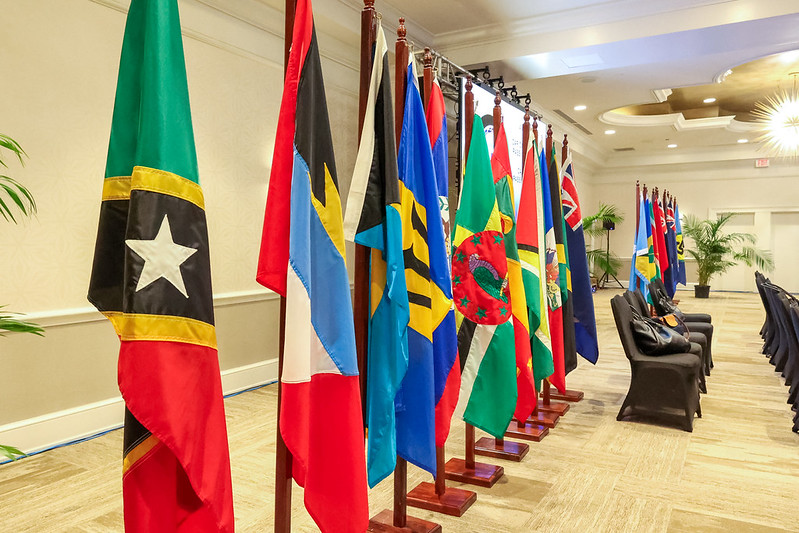
For CARICOM - the 15-member intergovernmental organization of Caribbean states - the principles of sovereignty, territorial integrity, peaceful resolution of disputes, and adherence to international law are paramount. The leaders of these states emphasize maintaining the Caribbean as a zone of peace while cooperating with international partners on issues such as narcotrafficking and the illegal arms trade.
In a statement released in late October 2025, 10 former CARICOM heads of state expressed their apprehension on the increased military security within the Caribbean archipelago, which they argue could endanger regional peace, stability, and development. They also warned that hosting military assets could draw the region into external conflicts and stressed the value of keeping the Caribbean Sea secure, protecting the lives and livelihoods of Caribbean citizens, and safeguarding the region's territorial integrity.
Amid ramped-up U.S. pressure on Cuba, CARICOM governments warn that a collapse of Cuban institutions - particularly its medical cooperation program - would deeply harm the region. They have called for dialogue and humanitarian support. Previous CARICOM heads of state have condemned the Trump administration's January 2026 executive order aimed at addressing threats the Cuban government supposedly poses to the United States as economic warfare and urged its repeal to alleviate the humanitarian crisis affecting 11 million Cubans.
Like state actors, Caribbean civil society groups see recent U.S. military activity as violations of sovereignty and international law, but they have generally adopted more radical views. Gary Aboud of the environmental advocacy group Fishermen and Friends of the Sea, for example, has framed U.S. actions as petroimperialist attempts to secure access to Venezuelan oil with potentially damaging effects on the sea and environment. Meanwhile, fisherfolk across the Caribbean report reduced activity due to fear of being harmed at sea, with significant impacts on low-income households.
While many Caribbean states and civil societies have been deeply critical of U.S. actions, there are divisions within the region. U.S. rhetoric on narco-trafficking resonates with Trinidad and Tobago, as well as Guyana, albeit to a lesser degree. These two countries were the only CARICOM members to take part in the U.S. Shield of Americas summit, further straining regional unity. Meanwhile, other members, like Barbados, have taken strong opposing positions, condemning extrajudicial killings and foreign military operations in Caribbean waters.
U.S.-China Competition and the Caribbean's Quest for Economic Sovereignty
Caribbean engagement with China reflects an effort to expand strategic autonomy. Since the 2000s, China has emerged to fill the void left by Western partners, offering infrastructure financing, development assistance, and trade opportunities without the conditionalities that often accompany Western financing.
As the international order becomes increasingly multipolar, many states and regions are looking to diversify their partnerships, and the Caribbean is no different. The region's strategy can be understood as asymmetric multi-alignment: maintaining strong ties with the United States while pragmatically engaging China and others in ways that serve national interests. This strategy also coincides with recent calls from Caribbean civil society for the region to reduce its reliance on foreign powers.
Caribbean Development and Security Proposals
Prominent Caribbean leaders and intellectuals are urging the region to strengthen its internal capacity and reduce foreign dependency.
In response to U.S. visa restrictions, Mark Brantley, the premier of Nevis and a former foreign minister of St. Kitts and Nevis, has called for reorienting Caribbean development toward deeper regional and South-South engagement. At the center of that strategy is attracting diaspora professionals back to the region - through land access, fiscal incentives, investment opportunities, and encouragement of local banking and entrepreneurship - as well as greater intraregional mobility.
Elsewhere, Professor Justin Robinson, a pro-vice chancellor and economist at the University of the West Indies Five Islands Campus, asserts that the region must assume responsibility for its future. He suggests that the region position climate adaptation as an export industry, build a world-class digital infrastructure, and transition to renewable energy. He also argues for greater integration among CARICOM states, including the development of a unified foreign policy. Finally, Robinson urges Caribbean citizens to demand more accountability from their governments and the private sector.
Saint Lucia is one Caribbean country already seeking to forge a new direction in its development agenda. On February 24, the government launched a national consultation to inform the country's first national development plan. In the meantime, the country's prime minister, Phillip J. Pierre, is emphasizing the need to build resilience by prioritizing food and water security.
Recommendations for U.S. Policymakers
Caribbean perceptions of U.S. unilateral action - characterized in their view by lack of consultation, disregard for international law, and harm to civilians - may undermine U.S. objectives and estrange Washington from the region. Deteriorating relations could result in reduced intelligence sharing, increased anti-U.S. sentiment and risks to U.S. citizens and assets, and declining confidence in the liberal-democratic values the U.S. promotes.
But U.S.-Caribbean relations don't have to be this way; it is in the interest of both the U.S. and the Caribbean to work together to have a safe and prosperous hemisphere. U.S. policymakers should support the Caribbean in countering military, economic, and coercive threats to its sovereignty to promote mutual interests. In that vein, U.S. policymakers can do the following:
- Expand cultural, educational, and health partnerships. This will build trust and reduce anti-U.S. sentiment.
- Expand anti-narcotics programs and other security initiatives. These programs should aim to improve surveillance, border control, and community policing; reduce corruption among security officers; strengthen investigative capacities; and reform Caribbean prisons. This type of collaboration will advance security for the United States and the Caribbean.
- Enhance Caribbean access to concessional financing. U.S. policymakers can advocate for a multidimensional development index at global financial institutions. This will help Caribbean nations address economic challenges that often drive migration, unemployment, crime, and other social ills.
- Prioritize CARICOM-wide and multilateral engagement. While the Trump administration has focused on bilateral negotiations, pursuing multilateral diplomacy will help reduce perceptions of divide-and-rule tactics and advance region-wide priorities and interests.
This paper series was published in collaboration with the Heinrich Böll Foundation, Washington D.C.