
click to zoom in
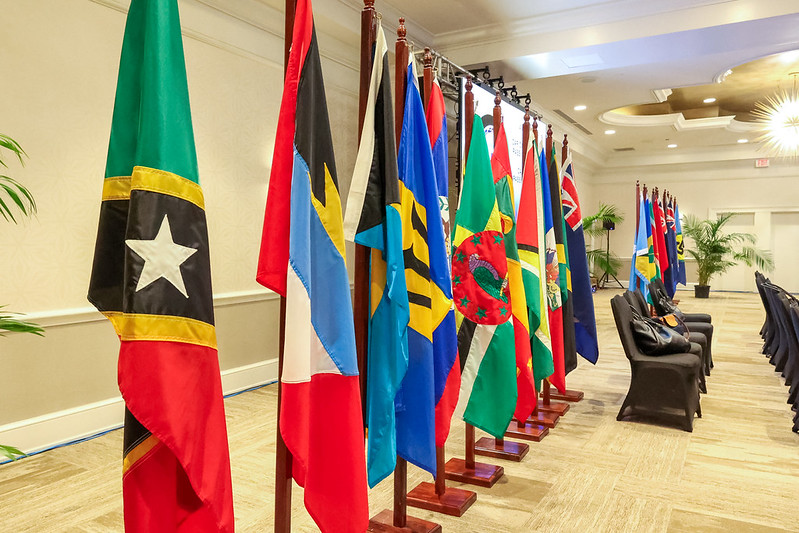
The Caribbean should be viewed as a heterogeneous region of contradictions. In recent decades, some Caribbean countries have evolved from mere small island developing states into petro-states and large ocean states, with vast sovereign maritime territory. Given the differences among these countries, the Caribbean Community (CARICOM) - a 15-member intergovernmental political and economic union of Caribbean states - has struggled to achieve regional integration, instead acting more as a community of sovereign states.
Indeed, the quest for integration, as former CARICOM Secretary-General Edwin Carrington put it, has challenged the regional body since its inception. Dr. Ralph Gonsalves, a former prime minister of Saint Vincent and the Grenadines, has said that Caribbean regional integration must be fashioned in such a way that the final product is more than a summation of its individual parts because if it is not, it does not make sense to have a union.
The second Trump administration's forceful approach to the Western Hemisphere has exacerbated CARICOM's integration challenges, as its members are divided over U.S. policies and how to respond.
The "Donroe" Doctrine and the Grenada Invasion
The Caribbean is often underemphasized in U.S. foreign policy. However, the Trump administration's prioritization of the Western Hemisphere and its assertion of the Donroe Doctrine have made the region a central focus of U.S. foreign policy. Caribbean states are grappling with tough U.S. policies directly imposed on them - such as strikes on alleged drug boats, insistence that Caribbean countries accept third-country deportees, and external calls for more U.S. military hardware in the region. Meanwhile, these states are also concerned about the implications of U.S. moves in their broader region, including the removal of Venezuelan President Nicolas Maduro and the pressure campaign on Cuba.
The administration's effort to assert dominance in the region harkens back to another moment that once defined U.S. posture in the region: the 1983 invasion of Grenada. The Grenada revolution's demise and the U.S.'s 1983 invasion - ostensibly under the guise of protecting regional stability and American citizens in the country - marked an inflection point for U.S. policy in the Caribbean. In short, Washington moved toward advancing U.S. interests regardless of Caribbean states' views on its aggressive stance toward the region.
The U.S. invasion also led to a reckoning in the region, with some states recognizing that requesting or supporting U.S. intervention, even to address an immediate threat, meant they could no longer uphold their non-aligned status or commitment to peaceful conflict resolution. Today, like then, Caribbean states must contend with a United States motivated primarily by advancing its national interests through commercial and military might.
The legacy of the U.S. intervention in Grenada remains mixed: some see it as a rescue mission to stave off anarchy, while others view it as a violation of Grenada's sovereignty. But Caribbean states derived important lessons. The U.S. invasion underscored the limits of sovereignty and the realities of power politics, according to Professor Ken Boodhoo. Although CARICOM states were signatories to the United Nations and the Organization of American States charters, which called on them to ensure regional peace and stability, they could do little if the United States decided to intervene in the affairs of any regional state. Today, as the Trump administration asserts its power prerogative in the region, the lessons from the Grenada invasion are increasingly relevant.
What Does this Mean for U.S.-Caribbean Relations?
CARICOM states have responded to U.S. intervention and security policies in Venezuela and the wider Caribbean by going into survival mode, reinforcing state sovereignty as paramount. The region is divided over Washington's policies, with some states viewing the United States as a friend while others see it as a threat.
Regardless of how they view their neighbor, most Caribbean states understand that commercial and military might, not diplomacy, will define Washington's policy toward the region in the years ahead. The backlash against these policies could result in diminished U.S. economic influence and market share, as Caribbean states may seek new suppliers and alternative financing options. Diversifying the region's diplomatic relationships can reduce the burden of dependence on the United States. Caribbean countries have sought alternative options and relations in recent years, engaging with the African Export-Import Bank and China on its Belt and Road Initiative. This trend will likely accelerate amid U.S. visa restrictions.
But even amid Washington's assertion of power politics, the United States has important reasons to maintain strong ties with the Caribbean states, which have leverage to advance their own interests, prosperity, and security. The Trump administration is clearly focused on security dynamics, as evidenced by its recent Shield of the Americas summit. The only CARICOM states invited to the summit were Guyana and Trinidad and Tobago. The Bahamas, Belize, and Jamaica have joined the Shield of Americas coalition, but were not represented at the summit. Nonetheless, while Trump has said the coalition will work to eradicate cartels, his administration has yet to explain how it will operate and how it can be a force for regional security.
The U.S. Congress can support CARICOM's regional unity and advance mutual interests by engaging with the organization's institutions, rather than emphasizing bilateral engagement with individual CARICOM states.
As Dr. Terrance Drew, the prime minister of St. Kitts and Nevis, noted at a recent CARICOM meeting, we are existing in a different political reality. In this new era, the Caribbean must maximize its resources to build a better future. If they can do so, Caribbean states may be able to play a larger role in shaping their region's economic and security future.
This paper series was published in collaboration with the Heinrich Böll Foundation, Washington D.C.